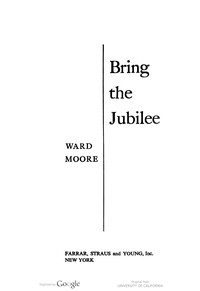
Bring the Jubilee
first published 1953 · free to read
length
63,934 words
a few pages a day
~8 min
finished in
34 days
full read
4h 26m
At Folio's default of ten pages a day, you finish Bring the Jubilee in about 34 days — roughly 8 minutes of reading each morning.
The opening
the first pages of Bring the Jubilee, free
Obvious typographical errors have been silently corrected. Variations in hyphenation been standardised but all other spelling and punctuation remains unchanged. Note in particular that the apostrophe is very rarely used to indicate abbreviation.
Italics are represented thus italic.
Bring the Jubilee
By Ward Moore
Breathe the Air Again Greener Than You Think Bring the Jubilee
This is an original novel—not a reprint—published by FARRAR, STRAUS & YOUNG, INC. The low price of $2.00 is made possible by large printings of combined editions.
Bring the Jubilee
WARD MOORE
FARRAR, STRAUS and YOUNG, Inc. NEW YORK
Copyright 1952 Fantasy House, Inc. Copyright 1953 Ward Moore All rights reserved. Manufactured in the U. S. A. Library of Congress catalog card number: 53-10417
BACK COVER MAP: BETTMANN ARCHIVE
For TONY BOUCHER and MICK McCOMAS who liked this story
What he will he does, and does so much That proof is call’d impossibility —Troilus and Cressida
It is always the puzzle of the nature of time that brings our thoughts to a standstill. And if time is so fundamental that an understanding of its true nature is for ever beyond our reach, then so also in all probability is a decision in the age-long controversy between determination and free will. —The Mysterious Universe by James Jeans
Contents
I Life in the Twenty-Six States 1
II Of Decisions, Minibiles, and Tinugraphs 12
III A Member of the Grand Army 22
IV Tyss 32
V Of Whigs and Populists 42
VI Enfandin 50
VII Of Confederate Agents in 1942 61
VIII In Violent Times 71
IX Barbara 76
X The Holdup 86
XI Of Haggershaven 95
XII More of Haggershaven 106
XIII Time 116
XIV Midbin’s Experiment 124
XV Good Years 132
XVI Of Varied Subjects 142
XVII HX-1 156
XVIII The Woman Tempted Me 166
XIX Gettysburg 175
XX Bring the Jubilee 181
XXI For the Time Being 191
1. LIFE IN THE TWENTY-SIX STATES
Although I am writing this in the year 1877, I was not born until 1921. Neither the dates nor the tenses are error—let me explain:
I was born, as I say, in 1921, but it was not until the early 1930’s, when I was about ten, that I began to understand what a peculiarly frustrate and disinherited world was about me. Perhaps my approach to realization was through the crayon portrait of Granpa Hodgins which hung, very solemnly, over the mantel.
Granpa Hodgins after whom I was named, perhaps a little grandiloquently, Hodgins McCormick Backmaker, had been a veteran of the War of Southron Independence. Like so many young men he had put on a shapeless blue uniform in response to the call of the ill-advised and headstrong—or martyred—Mr Lincoln. Depending on which of my lives’ viewpoints you take.
Granpa lost an arm on the Great Retreat to Philadelphia after the fall of Washington to General Lee’s victorious Army of Northern Virginia, so his war ended some six months before the capitulation at Reading and the acknowledgment of the independence of the Confederate States on July 4, 1864. One-armed and embittered, Granpa came home to Wappinger Falls and, like his fellow veterans, tried to remake his life in a different and increasingly hopeless world.
On its face the Peace of Richmond was a just and even generous disposition of a defeated foe by the victor. (Both sides—for different reasons—remembered the mutiny of the Unreconstructed Federals in the Armies of the Cumberland and the Tennessee who, despite defeat at Chattanooga, could not forget Vicksburg or Port Hudson and fought bloodily against the order to surrender.) The South could easily have carved the country up to suit its most fiery patriots, even to the point of detaching the West and making a protectorate of it. Instead the chivalrous Southrons contented themselves with drawing the new boundary along traditional lines. The Mason-Dixon gave them Delaware and Maryland, but they generously returned the panhandle of western Virginia jutting above it. Missouri was naturally included in the Confederacy, but of the disputed territory Colorado and Deseret were conceded to the old Union; only Kansas and California as well as—for obvious defensive reasons—Nevada’s tip went to the South.
Keep going from exactly here — Folio remembers your place and serves the next portion tomorrow.
continue reading Bring the JubileeAbout this free edition
Bring the Jubilee by Ward Moore (1903-1978) is free to read in full. Folio serves it in daily portions you can actually finish, tracks your streak and reading position across devices, and reads every page aloud with a built-in narrator. The text comes from Project Gutenberg.
More like Bring the Jubilee
Greener Than You Think
Folio
Greener Than You Think
Ward Moore
The Time Machine
H. G. Wells

The War of the Worlds
H. G. Wells

The Invisible Man
H. G. Wells
The Island of Doctor Moreau
H. G. Wells
The First Men in the Moon
H. G. Wells
The Sleeper Awakes
Folio
The Sleeper Awakes
H. G. Wells
The Food of the Gods and How It Came to Earth
Folio
The Food of the Gods and How It Came to Earth
H. G. Wells