length
53,285 words
a few pages a day
~8 min
finished in
29 days
full read
3h 42m
At Folio's default of ten pages a day, you finish Black No More in about 29 days — roughly 8 minutes of reading each morning.
The opening
the first pages of Black No More, free
Over twenty years ago a gentleman in Asbury Park, N. J. began manufacturing and advertising a preparation for the immediate and unfailing straightening of the most stubborn Negro hair. This preparation was called Kink-No-More, a name not wholly accurate since users of it were forced to renew the treatment every fortnight.
During the intervening years many chemists, professional and amateur, have been seeking the means of making the downtrodden Aframerican resemble as closely as possible his white fellow citizen. The temporarily effective preparations placed on the market have so far proved exceedingly profitable to manufacturers, advertising agencies, Negro newspapers and beauty culturists, while millions of users have registered great satisfaction at the opportunity to rid themselves of kinky hair and grow several shades lighter in color, if only for a brief time. With America's constant reiteration of the superiority of whiteness, the avid search on the part of the black masses for some key to chromatic perfection is easily understood. Now it would seem that science is on the verge of satisfying them.
Dr. Yusaburo Noguchi, head of the Noguchi Hospital at Beppu, Japan, told American newspaper reporters in October 1929, that as a result of fifteen years of painstaking research and experiment he was able to change a Negro into a white man. While he admitted that this racial metamorphosis could not be effected overnight, he maintained that "Given time, I could change the Japanese into a race of tall blue-eyed blonds." The racial transformation, he asserted, could be brought about by glandular control and electrical nutrition.
Even more positive is the statement of Mr. Bela Gati, an electrical engineer residing in New York City, who, in a letter dated August 18, 1930 and addressed to the National Association for the Advancement of Colored People said, in part:
"Once I myself was very strongly tanned by the sun and a European rural population thought that I was a Negro, too. I did not suffer much but the situation was disagreeable. Since that time I have studied the problem and I am convinced that the surplus of the pigment could be removed. In case you are interested and believe that with the aid of your physicians we could carry out the necessary experiments, I am willing to send you the patent specification ... and my general terms relating to this invention.... The expenses are so to say negligible."
I wish to express my sincere thanks and appreciation to Mr. V. F. Calverton for his keen interest and friendly encouragement and to my wife, Josephine Schuyler, whose coöperation and criticism were of great help in completing Black No More.
GEORGE S. SCHUYLER
NEW YORK CITY, September 1, 1930
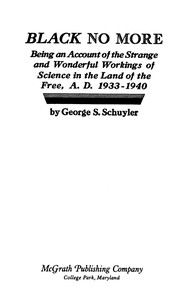
BLACK NO MORE
CHAPTER ONE
Max Disher stood outside the Honky Tonk Club puffing a panatela and watching the crowds of white and black folk entering the cabaret. Max was tall, dapper and smooth coffee-brown. His negroid features had a slightly satanic cast and there was an insolent nonchalance about his carriage. He wore his hat rakishly and faultless evening clothes underneath his raccoon coat. He was young, he wasn't broke, but he was damnably blue. It was New Year's Eve, 1933, but there was no spirit of gaiety and gladness in his heart. How could he share the hilarity of the crowd when he had no girl? He and Minnie, his high "yallah" flapper, had quarreled that day and everything was over between them.
Keep going from exactly here — Folio remembers your place and serves the next portion tomorrow.
continue reading Black No MoreAbout this free edition
Black No More by George S. Schuyler (1895-1977) is free to read in full. Folio serves it in daily portions you can actually finish, tracks your streak and reading position across devices, and reads every page aloud with a built-in narrator. The text comes from Project Gutenberg.
More like Black No More
The Time Machine
H. G. Wells

The War of the Worlds
H. G. Wells
The Invisible Man
H. G. Wells

The Island of Doctor Moreau
H. G. Wells
The First Men in the Moon
H. G. Wells
The Sleeper Awakes
Folio
The Sleeper Awakes
H. G. Wells
The Food of the Gods and How It Came to Earth
Folio
The Food of the Gods and How It Came to Earth
H. G. Wells

Frankenstein
Mary Shelley