length
39,141 words
a few pages a day
~8 min
finished in
21 days
full read
2h 43m
At Folio's default of ten pages a day, you finish Assyria in about 21 days — roughly 8 minutes of reading each morning.
The opening
the first pages of Assyria, free
Note: Project Gutenberg also has an HTML version of this file which includes the original illustrations. See 42033-h.htm or 42033-h.zip: (https://www.gutenberg.org/cache/epub/42033/pg42033-images.html) or (https://www.gutenberg.org/files/42033/42033-h.zip)
Images of the original pages are available through Internet Archive/Canadian Libraries. See http://archive.org/details/assyriaitsprince00saycuoft
Transcriber's note:
Text enclosed by underscores is in italics (italics).
Characters in small capitals were replaced as all capitals.
[Illustration: MONOLITH OF SHALMANESER II. (From the original in the British Museum.)]
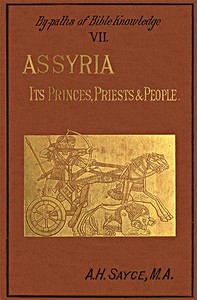
By-Paths of Bible Knowledge. VII.
ASSYRIA ITS PRINCES, PRIESTS, AND PEOPLE.
by
A. H. SAYCE, M.A.
Deputy Professor of Comparative Philology, Oxford, Hon. LL.D. Dublin, etc.
Author of 'Fresh Light from the Ancient Monuments,' 'An Introduction to Ezra, Nehemiah, and Esther,' etc.
London: The Religious Tract Society, 56, Paternoster Row, 65, St. Paul's Churchyard, and 164, Piccadilly. 1885.
CONTENTS. PAGE
List of Illustations 6
Preface 7
Chronological Table of the Kings of Assyria 17
Table of Biblical Dates according to Assyrian Monuments 19
I. The Country and People 21
II. Assyrian History 27
III. Assyrian Religion 55
IV. Art, Literature, and Science 86
V. Manners and Customs; Trade and Government 122
Appendix 146
Index 153
Index of Scripture References 166
ILLUSTRATIONS.
PAGE Monolith of Shalmaneser II. (from the original in the British Museum) Frontispiece
Assur-bani-pal and his Queen. (from the original in the British Museum) 49
Nergal. (from the original in the British Museum) 65
Fragment now in the British Museum showing primitive Hieroglyphics and Cuneiform Characters side by side. 93
An Assyrian Book. (from the original in the British Museum) 99
Part of an Assyrian Cylinder containing Hezekiah's Name. (from the original in the British Museum) 104
Assyrian King in his Chariot. 125
Siege of a City. 127
PREFACE.
Among the many wonderful achievements of the present century there is none more wonderful than the recovery and decipherment of the monuments of ancient Nineveh. For generations the great oppressing city had slept buried beneath the fragments of its own ruins, its history lost, its very site forgotten. Its name had passed into the region of myth even in the age of the classical writers of Greece and Rome; Ninos or Nineveh had become a hero-king about whom strange legends were told, and whose conquests were fabled to have extended from the Mediterranean to India. Little was known of the history of the mighty Assyrian Empire beyond what might be learnt from the Old Testament, and that little was involved in doubt and obscurity. Scholars wrote long treatises to reconcile the statements of Greek historians with those of Scripture, but they only succeeded in evolving theories which were contradicted and overthrown by the next writer. There was none so bold as to suggest that the history and life of Assyria were still lying hidden beneath the ground, ready to rise up and disclose their secrets at the touch of a magician's rod. The rod was the spade and the patient sagacity which deciphered and interpreted what the spade had found. It might have been thought that the cuneiform or wedge-shaped inscriptions of Assyria could never be forced to reveal their mysteries. The language in which they were written was unknown, and all clue to the meaning of the multitudinous characters that composed them had long been lost. No bilingual text came to the aid of the decipherer like the Rosetta Stone, whose Greek inscription had furnished the key to the meaning of the Egyptian hieroglyphics. Nevertheless the great feat was accomplished. Step by step the signification of the cuneiform characters and the words they concealed was made out, until it is now possible to translate an ordinary Assyrian text with as much ease and certainty as a page of the Old Testament.
Keep going from exactly here — Folio remembers your place and serves the next portion tomorrow.
continue reading AssyriaAbout this free edition
Assyria by A. H. Sayce (1845-1933) is free to read in full. Folio serves it in daily portions you can actually finish, tracks your streak and reading position across devices, and reads every page aloud with a built-in narrator. The text comes from Project Gutenberg.
More like Assyria
Patriarchal Palestine
Folio
Patriarchal Palestine
A. H. Sayce
Babylonians and Assyrians
Folio
Babylonians and Assyrians
A. H. Sayce
Fresh light from the ancient monuments
Folio
Fresh light from the ancient monuments
A. H. Sayce
A Primer of Assyriology
Folio
A Primer of Assyriology
A. H. Sayce
The Egypt of the Hebrews and Herodotos
Folio
The Egypt of the Hebrews and Herodotos
A. H. Sayce
The Hittites
Folio
The Hittites
A. H. Sayce
The History of the Peloponnesian War
Folio
The History of the Peloponnesian War
Thucydides
The History of Herodotus
Folio
The History of Herodotus
Herodotus