length
33,784 words
a few pages a day
~8 min
finished in
18 days
full read
2h 21m
At Folio's default of ten pages a day, you finish Art principles in literature in about 18 days — roughly 8 minutes of reading each morning.
The opening
the first pages of Art principles in literature, free
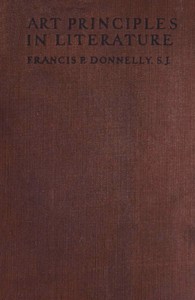
In the Art of Interesting (Kenedy, 1920) the writer began a discussion of the principles of art and of their application to writing and speaking. In this work the discussion is carried further and is not restricted to the one feature of arousing and fixing attention, especially in oratory, which was the chief topic of the Art of Interesting. The following chapters represent the reactions of the writer to literature both as composed today and as taught in our schools. Any active mind, bewildered by the ceaseless experimenting in literature and education, and not satisfied with a passive acceptance of even excellent critics, is necessarily forced back upon first principles. Such a mind will not yield to the despair of skepticism, that there are no first principles, nor to the despair of agnosticism, that there may be such principles but we cannot know them, nor yet to the despair of pragmatism, that we must wait and see whether the human race ages from now will give us assurance that there really are principles of art because the last man has seen that these principles have been found to work up to the moment prior to which he joined Tutankhamen.
Art, just as morals and pure science, differs entirely from the natural sciences, which are generalizations based upon acquired information and must change as long as the information upon which they are based can be modified and enlarged. But where, as in art or pure science, principles are based on final truths, the principles have also a finality and can only be rejected if their basis can be changed or modified. Aristotle’s principles have something of that finality. Aristotle had for his study a body of literature that has for centuries met with the approval of the best taste in every age and of every critic. Aristotle’s biology or physics are not final, but his ethics, his logic, his esthetics are in measurable distance of finality except where some additions have been made to the materials upon which he based his analysis. In religion, because of revelation, in music because of discoveries in instrumentation, and perhaps in other arts, time has added to the original store, but in literature there are few additions to the fields which lay before Aristotle, and subsequent ages have not developed any keener analytical powers than those of Aristotle.
It is Aristotle’s principles that in the main have dominated the writer’s reactions to modern art and literature. When Greek literature held an honored place in our schools, there was less need of insisting on obvious truths of art. The intense modernism now predominating everywhere has driven classical literature and classical methods from school and life. History is modernized too or fails to supply the vital contact with the ever-living past which earlier schools experienced in the poets, historians, orators and philosophers of Greece and Rome. So-called cultural subjects in modern education are chiefly informational. Culture is a word which calls for definition, but on its intellectual side at least, culture for the largest number of persons in the world can be gauged most satisfactorily by their appreciation of literature and by their capacity to produce literature. The study of literature as an art is the chief topic of this book, and Aristotle’s great principles need all the more stressing now that his philosophy of art and the supreme literature on which he based his conclusions are passing away from present-day consciousness.
Keep going from exactly here — Folio remembers your place and serves the next portion tomorrow.
continue reading Art principles in literatureAbout this free edition
Art principles in literature by Francis P. Donnelly (1869-1959) is free to read in full. Folio serves it in daily portions you can actually finish, tracks your streak and reading position across devices, and reads every page aloud with a built-in narrator. The text comes from Project Gutenberg.
More like Art principles in literature
Meditations
Folio
Meditations
Marcus Aurelius
The Enchiridion
Epictetus
Thus Spake Zarathustra
Friedrich Nietzsche
Beyond Good and Evil
Folio
Beyond Good and Evil
Friedrich Nietzsche
The Genealogy of Morals
Folio
The Genealogy of Morals
Friedrich Nietzsche
The Republic
Folio
The Republic
Plato
Apology
Folio
Apology
Plato
Crito
Folio
Crito
Plato