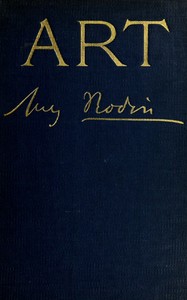
length
35,454 words
a few pages a day
~8 min
finished in
19 days
full read
2h 28m
At Folio's default of ten pages a day, you finish Art in about 19 days — roughly 8 minutes of reading each morning.
The opening
the first pages of Art, free
Not far from Paris, on the Seine, near Meudon, is a hamlet bearing the delightful name of Val-Fleury. Crowning the little hill above this village rises a group of buildings which in their charm and originality at once attract interest. You might almost guess that they belonged to an artist, and it is there, in fact, that Auguste Rodin has made his home.
Approaching, you find that the main buildings are three. The first, a Louis XIII. pavilion of red brick and freestone with a high-gabled roof, serves as his dwelling. Close by stands a great rotunda, entered through a columned portico, which is the one that in 1900 sheltered the special exhibition of Rodin’s work at the angle of the Pont de l’Alma in Paris; as it pleased him, he had it reerected upon this new site and uses it as his atelier. A little further on at the edge of the hill, which here falls steeply away, you see an eighteenth-century château—or rather only a façade—whose fine portal, under a triangular pediment, frames a wrought-iron gate; of this, more later.
This group, so diverse in character, is set in the midst of an idyllic orchard. The spot is certainly one of the most enchanting in the environs of Paris. Nature has done much for it, and the sculptor who settled here has beautified it with all the embellishments that his taste could suggest.
Last year, at the close of a beautiful day in May, as I walked with Auguste Rodin beneath the trees that shade his charming hill, I confided to him my wish to write, from his dictation, his ideas upon Art.
“You are an odd fellow,” he said. “So you are still interested in Art! It is an interest that is out-of-date.
[Illustration:
THE FLIGHT OF LOVE
By Rodin
Photograph reproduced by permission of the Boston Museum of Fine Arts ]
“To-day, artists and those who love artists seem like fossils. Imagine a megatherium or a diplodocus stalking the streets of Paris! There you have the impression that we must make upon our contemporaries. Ours is an epoch of engineers and of manufacturers, not one of artists.
“The search in modern life is for utility; the endeavor is to improve existence materially. Every day, science invents new processes for the feeding, clothing, or transportation of man; she manufactures cheaply inferior products in order to give adulterated luxuries to the greatest number—though it is true that she has also made real improvements in all that ministers to our daily wants. But it is no longer a question of spirit, of thought, of dreams. Art is dead.
“Art is contemplation. It is the pleasure of the mind which searches into nature and which there divines the spirit by which Nature herself is animated. It is the joy of the intellect which sees clearly into the Universe and which recreates it, with conscientious vision. Art is the most sublime mission of man, since it is the expression of thought seeking to understand the world and to make it understood.
“But to-day, mankind believes itself able to do without Art. It does not wish to meditate, to contemplate, to dream; it wishes to enjoy physically. The heights and the depths of truth are indifferent to it; it is content to satisfy its bodily appetites. Mankind to-day is brutish—it is not the stuff of which artists are made.
Keep going from exactly here — Folio remembers your place and serves the next portion tomorrow.
continue reading ArtAbout this free edition
Art by Auguste Rodin (1840-1917) is free to read in full. Folio serves it in daily portions you can actually finish, tracks your streak and reading position across devices, and reads every page aloud with a built-in narrator. The text comes from Project Gutenberg.
More like Art
Venus. To the Venus of Melos
Auguste Rodin
Meditations
Folio
Meditations
Marcus Aurelius
The Enchiridion
Epictetus

Thus Spake Zarathustra
Friedrich Nietzsche
Beyond Good and Evil
Folio
Beyond Good and Evil
Friedrich Nietzsche
The Genealogy of Morals
Folio
The Genealogy of Morals
Friedrich Nietzsche
The Republic
Folio
The Republic
Plato
Apology
Folio
Apology
Plato