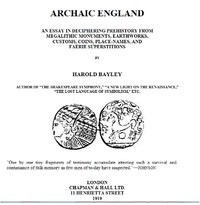
length
232,526 words
a few pages a day
~8 min
finished in
123 days
full read
16h 9m
At Folio's default of ten pages a day, you finish Archaic England in about 123 days — roughly 8 minutes of reading each morning.
The opening
the first pages of Archaic England, free
"Of all the many thousands of earthworks of various kinds to be found in England, those about which anything is known are very few, those of which there remains nothing more to be known scarcely exist. Each individual example is in itself a new problem in history, chronology, ethnology, and anthropology; within every one lie the hidden possibilities of a revolution in knowledge. We are proud of a history of nearly twenty centuries: we have the materials for a history which goes back beyond that time to centuries as yet undated. The testimony of records carries the tale back to a certain point: beyond that point is only the testimony of archæology, and of all the manifold branches of archæology none is so practicable, so promising, yet so little explored, as that which is concerned with earthworks. Within them lie hidden all the secrets of time before history begins, and by their means only can that history be put into writing: they are the back numbers of the island's story, as yet unread, much less indexed."--A. HADRIAN ALLCROFT.
"It is a gain to science that it has at last been recognised that we cannot penetrate far back into man's history without appealing to more than one element in that history. Some day it will be recognised that we must appeal to all elements in that history."--GOMME.
"History bears and requires Authors of all sorts."--CAMDEN.
CHAPTER I
INTRODUCTION
"If a man does not keep pace with his companions, perhaps it is because he hears a different drummer. Let him step to the music which he hears, however measured or far away."--H. D. THOREAU.
This book is an application of the jigsaw system to certain archæological problems which under the ordinary detached methods of the Specialist have proved insoluble. My fragments of evidence are drawn as occasion warrants from History, Fairy-tale, Philosophy, Legend, Folklore--in fact from any quarter whence the required piece unmistakably fulfils the missing space. It is thus a mental medley with all the defects, and some, I trust, of the attractions, of a mosaic.
Ten years ago I published a study on Mediæval Symbolism, and subsequent investigation of cognate subjects has since put me in possession of some curious and uncommon information, which lies off the mainroads of conventional Thought.
The consensus of opinion upon A New Light on the Renaissance,[1] was to the effect that my theories were decidedly ingenious and up to a point tenable, yet nevertheless at present they could only be regarded as non-proven. In 1912[2] I therefore endeavoured to substantiate my earlier propositions, pushing them much further to the point of suggesting an innate connection between Symbolism and certain words--such, for example, as psyche, which means a butterfly, and psyche the anima or soul which was symbolised or represented by a butterfly. Of course I knew only too well the tricky character of the ground I was exploring and how open many of my propositions would be to attack, yet it seemed preferable rather to risk the Finger of Scorn than by a superfluity of caution ignore clues, which under more competent hands might yield some very interesting and perhaps valuable discoveries.
Keep going from exactly here — Folio remembers your place and serves the next portion tomorrow.
continue reading Archaic EnglandAbout this free edition
Archaic England by Harold Bayley is free to read in full. Folio serves it in daily portions you can actually finish, tracks your streak and reading position across devices, and reads every page aloud with a built-in narrator. The text comes from Project Gutenberg.
More like Archaic England
The History of the Peloponnesian War
Folio
The History of the Peloponnesian War
Thucydides
The History of Herodotus
Folio
The History of Herodotus
Herodotus
The Gallic Wars
Folio
The Gallic Wars
Julius Caesar
Anabasis
Folio
Anabasis
Xenophon
The Lives of the Twelve Caesars
Folio
The Lives of the Twelve Caesars
Suetonius
Germania
Folio
Germania
Tacitus

The History of the Decline and Fall of the Roman Empire
Edward Gibbon
The Travels of Marco Polo
Marco Polo