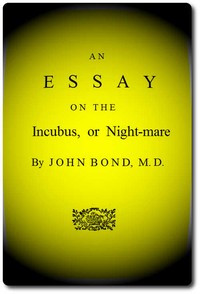
An Essay on the Incubus, or Night-mare
free to read
length
12,926 words
a few pages a day
~8 min
finished in
7 days
full read
54 min
At Folio's default of ten pages a day, you finish An Essay on the Incubus, or Night-mare in about 7 days — roughly 8 minutes of reading each morning.
The opening
the first pages of An Essay on the Incubus, or Night-mare, free
Your extensive knowlege in every branch of useful and polite literature will sufficiently justify the propriety of this address, though it offers to your acceptance and protection an Essay merely medical. Besides, the subject I have chosen is in a great measure new, and must, I think, if successfully treated, prove highly useful. It seems therefore peculiarly intitled to your patronage, who are so judicious, so generous, and so zealous a promoter of every discovery which may tend to the public good. I shall not trespass farther on your patience, with the usual apologies of young Authors; nor on your modesty, with the trite panegyrics of Dedicators: the whole tenour of your life has render’d such encomiums superfluous; for you have always pursued the shortest and the surest road to fame, the real esse quod videri velis.
Though by this Essay I should acquire no honour from the judicious Sons of Æsculapius; this one however I am sure of, the subscribing myself
Your most obliged,
And most devoted servant,
JOHN BOND.
THE
PREFACE.
Being much afflicted with the Night-mare, self-preservation made me particularly inquisitive about it. In consulting the ancient Physicians, I found little information concerning it, except dreadful prognostics; nor could a rational account of it be expected from them, as they were unacquainted with the circulation of the Blood.
The few Authors who have mention’d it since that glorious discovery, have also given imperfect accounts of it; which are probably owing to their not having felt it themselves: for, as it only seizes People in sleep, continues but a short time, and vanishes as soon as they awake, the Physician has not an opportunity of making observations of his own, but must take all from the description of others, who have labour’d under it. These, I believe, are the reasons that the principal Writers in Physic have taken so little notice of it. These omissions however render an enquiry into the nature of this Disease the more interesting and necessary, and, at the same time, the more difficult.
Under these disadvantages I have ventur’d to communicate the result of my own observations and reflexions on it; hoping, that a greater allowance will be made for the errors in this Essay, as it is perhaps the first that ever appear’d expressly on this subject.
The Night-mare is commonly, and, I believe, justly, attributed to a stagnation of the Blood; but how this stagnation is produc’d, has not been explain’d, so far as I know, in a satisfactory manner.
I have carefully collected the observations of the ancient Physicians concerning the prognostics of this Disorder; not for ostentation, but to shew at the same time the dangerous consequences and antiquity of it, in order to make those afflicted with it the more solicitous to remove its cause in the beginning; for it may be said of the Night-mare, as of many other Disorders, Vires acquirit eundo.
Though the most temperate are sometimes afflicted with this Disease, yet experience shews that it is generally the offspring of excess: hence it must have been nearly coeval with Bacchus (though it be omitted by the Coan Oracle;) and Homer probably alludes to its symptoms in the following lines:
Keep going from exactly here — Folio remembers your place and serves the next portion tomorrow.
continue reading An Essay on the Incubus, or Night-mareAbout this free edition
An Essay on the Incubus, or Night-mare by John M.D. Bond is free to read in full. Folio serves it in daily portions you can actually finish, tracks your streak and reading position across devices, and reads every page aloud with a built-in narrator. The text comes from Project Gutenberg.
More like An Essay on the Incubus, or Night-mare
Meditations
Folio
Meditations
Marcus Aurelius
The Enchiridion
Epictetus
Thus Spake Zarathustra
Friedrich Nietzsche
Beyond Good and Evil
Folio
Beyond Good and Evil
Friedrich Nietzsche
The Genealogy of Morals
Folio
The Genealogy of Morals
Friedrich Nietzsche
The Republic
Folio
The Republic
Plato
Apology
Folio
Apology
Plato
Crito
Folio
Crito
Plato