An Architect's Note-Book in Spain
free to read
length
49,211 words
a few pages a day
~8 min
finished in
26 days
full read
3h 25m
At Folio's default of ten pages a day, you finish An Architect's Note-Book in Spain in about 26 days — roughly 8 minutes of reading each morning.
The opening
the first pages of An Architect's Note-Book in Spain, free
Before quitting England for a first visit to Spain in the Autumn of 1869, I made up my mind both to see and draw as much of the Architectural remains of that country as the time and means at my disposal would permit; and further determined so to draw as to admit of the publication of my sketches and portions of my notes on the objects represented, in the precise form in which they might be made. I was influenced in that determination by the consciousness that almost from day to day the glorious past was being trampled out in Spain; and that whatever issue, prosperous or otherwise, the fortunes of that much distracted country might take in the future, the minor monuments of Art at least which adorned its soil, would rapidly disappear. Their disappearance would result naturally from what is called "progress" if Spain should revive; while their perishing through neglect and wilful damage, or peculation, would inevitably follow, if the ever smouldering embers of domestic revolution should burst afresh into flame. Such has been the invariable action of those fires which in all history have melted away the most refined evidences of man's intelligence, leaving behind only scanty, and often all but shapeless, relics of the richest and ripest genius.
It is difficult to realise the rapidity with which, almost under one's eyes, the Spain of history and romance "is casting its skin." Travelling even with so recent and so excellent a handbook as O'Shea's of 1869, I noted the following wanton acts of Vandalism and destruction, committed upon monuments of the greatest archæological and artistic interest since he wrote. At Seville, the Church of San Miguel, one of the oldest and finest in the city, was senselessly demolished by the populace as a sort of auto-da-fé, and by way of commemoration of the revolution of September, 1867. In exactly the same way the fine Byzantine churches of San Juan at Lerida, and of San Miguel at Barcelona, have been "improved off the face of the earth." Church plate, Custodias and Virils of the D'Arfés, Becerrias, and other Art workmen, have vanished from the treasuries of all the great ecclesiastical structures; whether sold, melted down, or only hidden, "quien sabe?" The beautiful Moorish decorations of the Alcazar at Segovia had been all but entirely destroyed by fire, attributed to the careless cigar-lighting of the Cadets to whom the structure had been abandoned. The finest old mansion in Barcelona, the Casa de Gralla, probably the masterpiece of Damian Forment, and dating from the commencement of the fourteenth century, has been pulled down by the Duke of Medina Celi to form a new street. The beautiful wooden ceiling of the Casa del Infantado at Guadalaxara, the finest of its kind in Spain, in the absence of its owner, who I was told lives in Russia, is coming down in large pieces, and once fallen, I scarcely think it will be in the power of living workmen to make it good again. The exquisite Moorish Palace of the Generalife at Granada, second only to the Alhambra and the Alcazar at Seville, is never visited by its proprietor, and is now one mass of white-wash, a victim of the zeal for cleanliness of a Sanitary "Administrador." In short to visit a Spanish city now, by the light shed upon its ancient glories by the industrious Ponz, is simply to have forced upon one's attention the most striking evidence of the "vanity of human things," and man's inherent tendency to destroy.
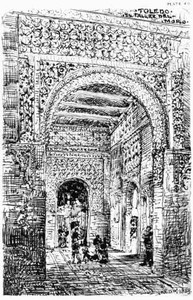
One of the most painful sensations the lover of the Art of the Past cannot but experience in Spain, is the feeling of its dissonance from, and irreconcileability with, the wants and economical necessities of to-day. The truth is that at the present moment, amongst the many difficult problems which surround and beset the ruling powers, one of the most puzzling is to find fitting uses for the many vast structures which have fallen into the hands of the Government. Churches in number and size out of all proportion to the wants of the population, monasteries entirely without monks, convents with scarcely any nuns, Jesuit seminaries without Jesuits, exchanges without merchants, colleges without students, tribunals of the Holy Inquisition with, thank God! no Inquisitors, and palaces without princes, are really "drugs in the market;" too beautiful to destroy, too costly to properly maintain, and for the original purposes for which they were planned and constructed at incredible outlay they stand now almost useless. For the most part, the grand architectural monuments of the country are now like Dickens' "used-up giants" kept only "to wait upon the dwarfs." Among a few instances of such, may be noticed the magnificent foundation of the noblest Spanish ecclesiastic, Ximenez. His College at Alcala de Heñares (see etext transcriber note) is turned into a young ladies' boarding-school; the splendid Convent of the Knights of Santiago at Leon, the masterpiece of Juan de Badajoz, dedicated to Saint Mark, and one of the finest buildings in Spain, is now in charge of a solitary policeman and his wife, awaiting its possible conversion into an agricultural college; the grand Palace of the Dukes of Alva at Seville is let out in numerous small tenements and enriched with unlimited whitewash; the Colegiata of San Gregorio at Valladolid, another of the magnificent foundations of Cardinal Ximenez, and the old cathedral at Lerida, the richest Byzantine monument in Spain, are now both barracks;--the vast exchanges of Seville and Saragossa are tenantless and generally shut up; the beautiful "Casa de los Abades" at Seville is converted into a boy's school and lodging-house for numerous poor tenants, the Casa del Infante at Saragossa, containing the most richly sculptured Renaissance Patio in Spain, is chiefly occupied as a livery stable-keeper's establishment; Cardinal Mendoza's famous Hospital of the Holy Cross at Toledo is now an Infantry College; the great monastery of the Cartuja near Seville, with one of the finest Mudejar wooden ceilings in the country, is turned into Pickman's china factory; the "Taller del Moro" a model Moorish house with its beautiful decorations, at Toledo, is now only a carpenter's workshop and storehouse; the celebrated establishment of El Cristo de la Victoria at Malaga, with all its glorious associations with the "Reyes Cattolicos," is occupied as a military hospital; and so on 'ad infinitum.'
Keep going from exactly here — Folio remembers your place and serves the next portion tomorrow.
continue reading An Architect's Note-Book in SpainAbout this free edition
An Architect's Note-Book in Spain by M. Digby Wyatt (1820-1877) is free to read in full. Folio serves it in daily portions you can actually finish, tracks your streak and reading position across devices, and reads every page aloud with a built-in narrator. The text comes from Project Gutenberg.
More like An Architect's Note-Book in Spain
The History of the Peloponnesian War
Folio
The History of the Peloponnesian War
Thucydides
The History of Herodotus
Folio
The History of Herodotus
Herodotus
The Gallic Wars
Folio
The Gallic Wars
Julius Caesar
Anabasis
Folio
Anabasis
Xenophon
The Lives of the Twelve Caesars
Folio
The Lives of the Twelve Caesars
Suetonius
Germania
Folio
Germania
Tacitus

The History of the Decline and Fall of the Roman Empire
Edward Gibbon

The Travels of Marco Polo
Marco Polo