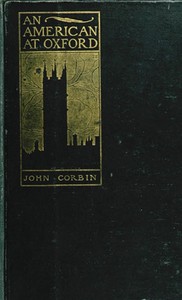
An American at Oxford
free to read
length
65,726 words
a few pages a day
~8 min
finished in
35 days
full read
4h 34m
At Folio's default of ten pages a day, you finish An American at Oxford in about 35 days — roughly 8 minutes of reading each morning.
The opening
the first pages of An American at Oxford, free
By a curious coincidence, the day on which the last proof of this book was sent to the printer saw the publication of the will of the late Cecil Rhodes, providing that each of the United States is forever to be represented at Oxford by two carefully selected undergraduate students. That the plan will result in any speedy realization of the ideals of the great exponent of English power in the new worlds is perhaps not to be expected. For the future of American education, on the other hand, few things could be more fortunate. Native and independent as our national genius has always been, and seems likely to remain, it has always been highly assimilative. In the past, we have received much needed aliment from the German universities. For the present, the elements of which we have most need may best, as I think, be assimilated from England.
Whether or not Americans at Oxford become imbued with Mr. Rhodes's conceptions as to the destiny of the English peoples, they can scarcely fail to observe that Oxford affords to its undergraduates a very sensibly ordered and invigorating life, a very sensibly ordered and invigorating education. This, as I have endeavored to point out in the following pages, our American universities do not now afford, nor are they likely to afford it until the social and the educational systems are more perfectly organized than they have ever been, or seem likely to be, under the dominance of German ideals. If, however, the new Oxford-trained Americans should ever become an important factor in our university life, the future is bright with hope. We have assimilated, or are assimilating, the best spirit of German education; and if we were to make a similar draft on the best educational spirit in England, our universities would become far superior as regards their organization and ideals, and probably also as regards what they accomplish, to any in Europe. The purpose and result of an introduction of English methods would of course not be to imitate foreign custom, but to give fuller scope to our native character, so that if the American educational ideals in the end approximate the English more closely than they do at present, such a result would be merely incidental to the fact that the two countries have at bottom much the same social character and instincts. If Mr. Rhodes's dream is to be realized, it will probably be in some such tardy and roundabout but admirably vital manner as this.
At a superficial glance the testator's intention seems to have been to send the students to Oxford directly from American schools. Such a course, it seems to me, could only work harm. Even if the educational and residential facilities afforded at Oxford were on the whole superior to those of American universities, which they are not, the difference could not compensate the student for the loss of his American university course with all it means in forming lifelong friendships among his countrymen and in assimilating the national spirit. If, however, the Oxford scholarships were awarded to recent graduates of American universities, the greatest advantage might result. The student might then modify his native training so as to complete it and make it more effective. Now the wording of the testament requires only that the American scholars shall "commence residence as undergraduates." This they will be able to do whatever their previous training, and in fact this is what Americans at Oxford have always done in the past. The most valuable A.B. leaves the field of human knowledge far from exhausted; and the methods of instruction and of examining at Oxford are so different from anything we know that it has even proved worth while for the American to repeat at Oxford the same studies he took in America. The executors of the will should be most vigorously urged to select the scholars from the graduates of American universities.
Keep going from exactly here — Folio remembers your place and serves the next portion tomorrow.
continue reading An American at OxfordAbout this free edition
An American at Oxford by John Corbin (1870-1959) is free to read in full. Folio serves it in daily portions you can actually finish, tracks your streak and reading position across devices, and reads every page aloud with a built-in narrator. The text comes from Project Gutenberg.
More like An American at Oxford
The History of the Peloponnesian War
Folio
The History of the Peloponnesian War
Thucydides
The History of Herodotus
Folio
The History of Herodotus
Herodotus
The Gallic Wars
Folio
The Gallic Wars
Julius Caesar
Anabasis
Folio
Anabasis
Xenophon
The Lives of the Twelve Caesars
Folio
The Lives of the Twelve Caesars
Suetonius
Germania
Folio
Germania
Tacitus

The History of the Decline and Fall of the Roman Empire
Edward Gibbon
The Travels of Marco Polo
Marco Polo