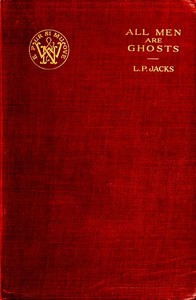
All Men Are Ghosts
first published 1913 · free to read
length
63,568 words
a few pages a day
~8 min
finished in
34 days
full read
4h 25m
At Folio's default of ten pages a day, you finish All Men Are Ghosts in about 34 days — roughly 8 minutes of reading each morning.
The opening
the first pages of All Men Are Ghosts, free
Of the stories in this volume, "Farmer Jeremy and his Ways" has already appeared in the Cornhill; "The Magic Formula," "The Professor's Mare," and "White Roses" in the Atlantic Monthly. These are reprinted with the permission of the respective Editors. Some additions have been made which were precluded by the shorter form of the magazine story.
"He that hath found some fledged bird's nest may know, At first sight, if the bird be flown; But what fair well or grove he sings in now, That is to him unknown.
And yet, as angels in some brighter dreams Call to the soul while man doth sleep; So some strange thoughts transcend our wonted themes, And into glory peep."
HENRY VAUGHAN, 1655.
ALL MEN ARE GHOSTS
PANHANDLE AND THE GHOSTS
"'Oh,' dissi lui, 'Or se' tu ancor morto?' Ed egli a me, 'Come il mio corpo stea Nel mondo su, nulla scienza porto.'"
DANTE, Inferno, Canto xxxiii.
I
PANHANDLE LAYS DOWN A PRINCIPLE
"The first principle to guide us in the study of the subject," said Panhandle, "is that no genuine ghost ever recognised itself as what you suppose it to be. The conception which the ghost has of its own being is fundamentally different from yours. Because it lacks solidity you deem it less real than yourself. The ghost thinks the opposite. You imagine that its language is a squeak. From the ghost's point of view the squeaker is yourself. In short, the attitude of mankind towards the realm of ghosts is regarded by them as a continual affront to the majesty of the spiritual world, perpetrated by beings who stand on a low level of intelligence; and for that reason they seldom appear or make any attempt at open communication, doing their work in secret and disclosing their identity only to selected souls. Far from admitting that they are less real than you, they regard themselves as possessed of reality vastly more intense than yours. Imagine what your own feelings would be if, at this moment, I were to treat you as a gibbering bogey, and you will then have some measure of the contempt which ghosts entertain for human beings."
"You must confess, my dear Panhandle," I answered, "that you are flying in the face of the greatest authorities, and have the whole literature of the subject against you. You tell me that no genuine ghost ever recognised itself as such."
"I mean, of course," interrupted Panhandle, "that it never recognised itself as a ghost in your inadequate sense of the term."
"Then," said I, "what do you make of the Ghost's words in Hamlet:
'I am thy father's spirit'?
This one, at all events, recognised itself as such."
"In attributing those words to the Ghost," said Panhandle, "Shakespeare was using him as a stage property and as a means of playing to the gallery, which is incapable of right notions on this subject. But there is another passage in the same group of scenes which shows that Shakespeare was not wholly ignorant of the inner mind of ghosts. Listen to this:--
'Enter Ghost.
Horatio. What art thou, that usurp'st this time of night, Together with that fair and warlike form In which the majesty of buried Denmark Did sometimes march? By Heaven I charge thee, speak!
Marcellus. It is offended.
Bernardo. See, it stalks away'"
"Now, what does that mean?" he continued. "The words of Horatio imply that the Ghost has usurped a reality which does not belong to him; that he is a wraith, a goblin, or some such absurdity--that, in short, he is going to be treated in the idiotic manner which is usual with men in the presence of such apparitions. Doubtless the Ghost saw that these men were afraid of him, that their hair was standing on end and their knees knocking together. Disgusted at such an exhibition of what to him would appear as a mixture of stupidity and bad manners, he turned up his nose at the lot of them and stalked away in wrath. No self-respecting ghost would ever consent to be so treated; and that may help you to understand why communications from the world of spirits are comparatively rare. Ghosts who believe in the existence of human beings often regard them as idiots. To communicate with such imbeciles is to court an insult, or at least to expose the communicating spirit to an exhibition of revolting antics and limited intelligence. From their point of view, men are a race of beings whose acquaintance is not worth cultivating."
Keep going from exactly here — Folio remembers your place and serves the next portion tomorrow.
continue reading All Men Are GhostsAbout this free edition
All Men Are Ghosts by L. P. Jacks (1860-1955) is free to read in full. Folio serves it in daily portions you can actually finish, tracks your streak and reading position across devices, and reads every page aloud with a built-in narrator. The text comes from Project Gutenberg.
More like All Men Are Ghosts
Dracula
Bram Stoker
The Strange Case of Dr. Jekyll and Mr. Hyde
Robert Louis Stevenson
The Turn of the Screw
Folio
The Turn of the Screw
Henry James
The Picture of Dorian Gray
Oscar Wilde
The Fall of the House of Usher
Folio
The Fall of the House of Usher
Edgar Allan Poe
Carmilla
Joseph Sheridan Le Fanu
Uncle Silas
Folio
Uncle Silas
Joseph Sheridan Le Fanu
The Castle of Otranto
Folio
The Castle of Otranto
Horace Walpole