length
167,887 words
a few pages a day
~8 min
finished in
89 days
full read
11h 40m
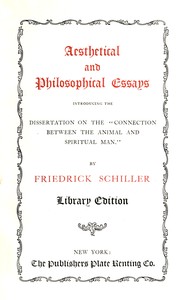
At Folio's default of ten pages a day, you finish Aesthetical and philosophical essays in about 89 days — roughly 8 minutes of reading each morning.
The opening
the first pages of Aesthetical and philosophical essays, free
The special subject of the greater part of the letters and essays of Schiller contained in this volume is Æsthetics; and before passing to any remarks on his treatment of the subject it will be useful to offer a few observations on the nature of this topic, and on its treatment by the philosophical spirit of different ages.
First, then, æsthetics has for its object the vast realm of the beautiful, and it may be most adequately defined as the philosophy of art or of the fine arts. To some the definition may seem arbitrary, as excluding the beautiful in nature; but it will cease to appear so if it is remarked that the beauty which is the work of art is higher than natural beauty, because it is the offspring of the mind. Moreover, if, in conformity with a certain school of modern philosophy, the mind be viewed as the true being, including all in itself, it must be admitted that beauty is only truly beautiful when it shares in the nature of mind, and is mind’s offspring.
Viewed in this light, the beauty of nature is only a reflection of the beauty of the mind, only an imperfect beauty, which as to its essence is included in that of the mind. Nor has it ever entered into the mind of any thinker to develop the beautiful in natural objects, so as to convert it into a science and a system. The field of natural beauty is too uncertain and too fluctuating for this purpose. Moreover, the relation of beauty in nature and beauty in art forms a part of the science of æsthetics, and finds again its proper place.
But it may be urged that art is not worthy of a scientific treatment. Art is no doubt an ornament of our life and a charm to the fancy; but has it a more serious side? When compared with the absorbing necessities of human existence, it might seem a luxury, a superfluity, calculated to enfeeble the heart by the assiduous worship of beauty, and thus to be actually prejudicial to the true interest of practical life. This view seems to be largely countenanced by a dominant party in modern times, and practical men, as they are styled, are only too ready to take this superficial view of the office of art.
Many have indeed undertaken to defend art on this score, and to show that, far from being a mere luxury, it has serious and solid advantages. It has been even apparently exaggerated in this respect, and represented as a kind of mediator between reason and sense, between inclination and duty, having as its mission the work of reconciling the conflicting elements in the human heart. A strong trace of this view will be found in Schiller, especially in all that he says about the play instinct in his “Æsthetical Letters.”
Nevertheless, art is worthy of science; æsthetics is a true science, and the office of art is as high as that assigned to it in the pages of Schiller. We admit that art viewed only as an ornament and a charm is no longer free, but a slave. But this is a perversion of its proper end. Science has to be considered as free in its aim and in its means, and it is only free when liberated from all other considerations; it rises up to truth, which is its only real object, and can alone fully satisfy it. Art in like manner is alone truly art when it is free and independent, when it solves the problem of its high destination—that problem whether it has to be placed beside religion and philosophy as being nothing else than a particular mode or a special form of revealing God to consciousness, and of expressing the deepest interests of human nature and the widest truths of the human mind.
For it is in their works of art that the nations have imprinted their favorite thoughts and their richest intuitions, and not unfrequently the fine arts are the only means by which we can penetrate into the secrets of their wisdom and the mysteries of their religion.
Keep going from exactly here — Folio remembers your place and serves the next portion tomorrow.
continue reading Aesthetical and philosophical essaysAbout this free edition
Aesthetical and philosophical essays by Friedrich Schiller (1759-1805) is free to read in full. Folio serves it in daily portions you can actually finish, tracks your streak and reading position across devices, and reads every page aloud with a built-in narrator. The text comes from Project Gutenberg.
More like Aesthetical and philosophical essays
The Ghost-Seer; or, The Apparitionist
Folio
The Ghost-Seer; or, The Apparitionist
Friedrich Schiller
Philosophical Letters of Friedrich Schiller
Folio
Philosophical Letters of Friedrich Schiller
Friedrich Schiller
Aesthetical Essays of Friedrich Schiller
Folio
Aesthetical Essays of Friedrich Schiller
Friedrich Schiller
The History of the Thirty Years' War
Folio
The History of the Thirty Years' War
Friedrich Schiller

The Thirty Years War — Complete
Friedrich Schiller
History of the Revolt of the Netherlands — Complete
Folio
History of the Revolt of the Netherlands — Complete
Friedrich Schiller
Meditations
Folio
Meditations
Marcus Aurelius
The Enchiridion
Epictetus