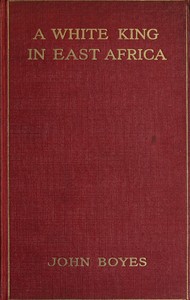
A White King in East Africa
first published 1911 · free to read
length
80,262 words
a few pages a day
~8 min
finished in
43 days
full read
5h 34m
At Folio's default of ten pages a day, you finish A White King in East Africa in about 43 days — roughly 8 minutes of reading each morning.
The opening
the first pages of A White King in East Africa, free
This version of the text cannot represent certain typographical effects. Italics are delimited with the ‘’ character as italic_.
Footnotes have been moved to follow the paragraphs in which they are referenced. Photographic illustrations are also moved to fall on paragraph breaks.
Minor errors, attributable to the printer, have been corrected. Please see the transcriber’s note at the end of this text for details regarding the handling of any textual issues encountered during its preparation.
A WHITE KING IN EAST AFRICA
[Illustration: JOHN BOYES]
A WHITE KING IN EAST AFRICA
THE REMARKABLE ADVENTURES OF JOHN BOYES, TRADER AND SOLDIER OF FORTUNE, WHO BECAME KING OF THE SAVAGE WA-KIKUYU
WRITTEN BY HIMSELF
EDITED BY C. W. L. BULPETT
WITH TWELVE ILLUSTRATIONS AND A MAP
NEW YORK McBRIDE, NAST & COMPANY 1912
(All rights reserved.)
TO
WILLIAM NORTHROP McMILLAN
IN MEMORY OF MANY TRAMPS TOGETHER
EDITOR’S PREFACE
The following pages describe a life of adventure in the more remote parts of Africa—adventures such as the explorer and sportsmen do not generally encounter. The man to whom the episodes narrated in this book refer has been personally known to me for ten years. We have hunted big game and explored together many a time in the African jungle; and as it is principally at my instigation that he has put the following account of his experiences into writing, I think it is due to him and to the public that I should make known my responsibility in the matter.
It seemed to me that the adventures John Boyes underwent were something quite out of the common; in these matter-of-fact days they may be said to be almost unique. In the days of exploration and discovery, when Captain Cook and such heroes lived and thrived, they were perhaps common enough; but every year the opportunities of such adventure get more and more remote, and as the uttermost parts of the earth are brought under the influence of civilization will become ever more impossible. For this reason alone a story such as told here seems to be worth recording.
There is no attempt at literary style. The man tells his tale in a simple, matter-of-fact way, and, as his Editor, I have thought it better from every point of view to leave his words as he has written them.
The reader will judge for himself as to the interest of the adventures here related, but I think any one will admit that no ordinary force of character was necessary to carry them through to a successful issue. The whole life of the author during the time he was a wanderer in the Kikuyu country, and later while he was practically supreme ruler of the tribe—a tribe numbering half a million of people—was one of imminent daily risk.
Each hour he went about with his life in his hands, and if he came out scatheless from the mêlée, he has only to thank his courage, nerve, and resource. All these qualities he obviously possessed in a high degree.
He appears to have been harshly treated by the British East Africa authorities. Doubtless much that he did was grossly misrepresented to them by more or less interested parties. He certainly did yeoman’s service to the colony in its early days by opening up an unknown and hostile country which lay right on the borderland of the Uganda Railway, at that time in course of construction. His energetic action enabled the coolies on the line to work safe from many hostile attacks. He supplied them with the food without which they would have starved—all for a very small reward, and at great personal risk to himself. But the love of adventure was in him, and such people do not work for profit alone. The life itself brings its own reward.
An impartial observer will perhaps be able to understand the point of view of the British Administration, and will appreciate their difficulty, indeed their ability, to allow an independent white power to rule beside their own; but the public will judge for themselves whether they set about to do what they did with regard to John Boyes in the most tactful way, or whether they treated a brave fellow-countryman in the manner he deserved.
Keep going from exactly here — Folio remembers your place and serves the next portion tomorrow.
continue reading A White King in East AfricaAbout this free edition
A White King in East Africa by John Boyes (1874-1951) is free to read in full. Folio serves it in daily portions you can actually finish, tracks your streak and reading position across devices, and reads every page aloud with a built-in narrator. The text comes from Project Gutenberg.
More like A White King in East Africa
Treasure Island
Robert Louis Stevenson
Kidnapped
Robert Louis Stevenson
The Call of the Wild
Jack London
White Fang
Jack London
The Sea-Wolf
Jack London
The Count of Monte Cristo
Alexandre Dumas
The Three Musketeers
Folio
The Three Musketeers
Alexandre Dumas
Robinson Crusoe
Folio
Robinson Crusoe
Daniel Defoe