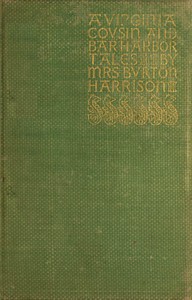
length
34,637 words
a few pages a day
~8 min
finished in
19 days
full read
2h 24m
At Folio's default of ten pages a day, you finish A Virginia Cousin, & Bar Harbor Tales in about 19 days — roughly 8 minutes of reading each morning.
The opening
the first pages of A Virginia Cousin, & Bar Harbor Tales, free
The little story "A Virginia Cousin," here put into print for the first time, is in some sort a tribute offered by a long-exiled child of the South to her native soil. It is also a transcript of certain phases of that life in the metropolis which has been pooh-poohed by some critics as trivially undeserving of a chronicler, but fortunate hitherto in finding a few readers willing to concede as much humanity to the "heroine in satin" as to the "confidante in linen."
Of the other contents of this volume, "Out of Season" made its first appearance some time ago in Two Tales, and "On Frenchman's Bay" was published in The Cosmopolitan Magazine.
C. C. H.
NEW YORK, November, 1895
A Virginia Cousin
Chapter I
Mr. Theodore Vance Townsend awoke to the light of a spring morning in New York, feeling at odds with the world. The cause for this state of variance with existing circumstances was not at sight apparent. He was young, good-looking, well-born, well-mannered, and, to support these claims to favorable consideration, had come into the fortunes of a father and two maiden aunts,--a piece of luck that had, however, not secured for him the unqualified approbation of his fellow-citizens.
Joined to the fact that, upon first leaving college, some years before, he had led a few cotillons at New York balls, his wealth and leisure had brought upon Townsend the reproach of the metropolitan press to the extent that nothing short of his committing suicide would have induced it to look upon anything he did as in earnest.
With an inherited love of letters, he had dabbled in literature so far as to write and publish a book of verse, of fair merit, which, however, had been received with tumultuous rhapsodies of satire by the professional critics. The style and title of "Laureate of the 400," applied in this connection, had indeed clung to him and made life hateful in his sight. To escape it and the other rubs of unoccupied solvency, he had made many journeys into foreign countries, had gone around the globe, and, in due course, had always come to the surface in New York again, with a sort of doglike attachment to the place of his birth that would not wear away.
Of the society he was familiar with, Vance was profoundly weary. Of domestic ties, he had only a sister, married to a rich banker, and in possession of a fine new house, whose tapestries and electric lighting occupied all her thoughts and conversation that could be spared for things indoors. Away from home, Mrs. Clifton was continually on the wing, attending to the demands of philanthropy or charity, and to cultivation of the brain in classes of women of incomes equal to her own. Whenever her brother dined with her, she entertained him with a voluble flow of conversation about these women and their affairs, never failing, however, to exhibit her true sisterly feeling by telling Vance that she could not see why in the world he did not marry Kitty Ainger and settle down.
By dint of much iteration, this suggestion of Kitty Ainger as a wife had come to take languid possession of the young man's brain. Besides, he liked Miss Ainger as well as admired her, and was perhaps more content in her company than in that of anybody else he knew.
On the spring morning in question, he had awaked in a flood of sunshine and fresh air that poured through the open windows of his room. His cold bath, his simple breakfast, his ride in the Park, brought his sensations of physical well-being to a point that almost excited his spirits to strike a balance of youthful cheerfulness. He forgot his oppressive belongings, the obloquy they had conferred upon him in the minds of men who make public opinion about others as citizens, his unreasonable stagnation of ambition.
As he cantered along the equestrian byways of the Park, and felt, without noting, the stir of new life in nature, he grew light of heart and buoyant. And as this condition increased, his thoughts crystallized around the image of Katherine Ainger. She, too, loved her morning ride; no doubt he should meet her presently. He had not seen her since Thursday of last week, when he had taken her in to dinner at Mrs. Cartwright's; and he had a vague idea she had resented him a little on that occasion. Her talk had been a trifle baffling, her eyes evasive. But she had worn a stunning gown, and was by all odds the best-looking woman of the lot. How well she sat at table, by the way! What an admirable figure for a man who would be forced to entertain, to place at the head of his board in perpetuity!
Keep going from exactly here — Folio remembers your place and serves the next portion tomorrow.
continue reading A Virginia Cousin, & Bar Harbor TalesAbout this free edition
A Virginia Cousin, & Bar Harbor Tales by Burton Harrison (1843-1920) is free to read in full. Folio serves it in daily portions you can actually finish, tracks your streak and reading position across devices, and reads every page aloud with a built-in narrator. The text comes from Project Gutenberg.
More like A Virginia Cousin, & Bar Harbor Tales
Latter-Day Sweethearts
Burton Harrison
Pride and Prejudice
Jane Austen
Sense and Sensibility
Jane Austen
Emma
Folio
Emma
Jane Austen
Persuasion
Folio
Persuasion
Jane Austen
Mansfield Park
Folio
Mansfield Park
Jane Austen
Jane Eyre
Charlotte Brontë
The Tenant of Wildfell Hall
Folio
The Tenant of Wildfell Hall
Anne Brontë