length
90,040 words
a few pages a day
~8 min
finished in
48 days
full read
6h 15m
At Folio's default of ten pages a day, you finish A Texas Matchmaker in about 48 days — roughly 8 minutes of reading each morning.
The opening
the first pages of A Texas Matchmaker, free
When I first found employment with Lance Lovelace, a Texas cowman, I had not yet attained my majority, while he was over sixty. Though not a native of Texas, “Uncle Lance” was entitled to be classed among its pioneers, his parents having emigrated from Tennessee along with a party of Stephen F. Austin’s colonists in 1821. The colony with which his people reached the state landed at Quintana, at the mouth of the Brazos River, and shared the various hardships that befell all the early Texan settlers, moving inland later to a more healthy locality. Thus the education of young Lovelace was one of privation. Like other boys in pioneer families, he became in turn a hewer of wood or drawer of water, as the necessities of the household required, in reclaiming the wilderness. When Austin hoisted the new-born Lone Star flag, and called upon the sturdy pioneers to defend it, the adventurous settlers came from every quarter of the territory, and among the first who responded to the call to arms was young Lance Lovelace. After San Jacinto, when the fighting was over and the victory won, he laid down his arms, and returned to ranching with the same zeal and energy. The first legislature assembled voted to those who had borne arms in behalf of the new republic, lands in payment for their services. With this land scrip for his pay, young Lovelace, in company with others, set out for the territory lying south of the Nueces. They were a band of daring spirits. The country was primitive and fascinated them, and they remained. Some settled on the Frio River, though the majority crossed the Nueces, many going as far south as the Rio Grande. The country was as large as the men were daring, and there was elbow room for all and to spare. Lance Lovelace located a ranch a few miles south of the Nueces River, and, from the cooing of the doves in the encinal, named it Las Palomas.
“When I first settled here in 1838,” said Uncle Lance to me one morning, as we rode out across the range, “my nearest neighbor lived forty miles up the river at Fort Ewell. Of course there were some Mexican families nearer, north on the Frio, but they don’t count. Say, Tom, but she was a purty country then! Why, from those hills yonder, any morning you could see a thousand antelope in a band going into the river to drink. And wild turkeys? Well, the first few years we lived here, whole flocks roosted every night in that farther point of the encinal. And in the winter these prairies were just flooded with geese and brant. If you wanted venison, all you had to do was to ride through those mesquite thickets north of the river to jump a hundred deer in a morning’s ride. Oh, I tell you she was a land of plenty.”
The pioneers of Texas belong to a day and generation which has almost gone. If strong arms and daring spirits were required to conquer the wilderness, Nature seemed generous in the supply; for nearly all were stalwart types of the inland viking. Lance Lovelace, when I first met him, would have passed for a man in middle life. Over six feet in height, with a rugged constitution, he little felt his threescore years, having spent his entire lifetime in the outdoor occupation of a ranchman. Living on the wild game of the country, sleeping on the ground by a camp-fire when his work required it, as much at home in the saddle as by his ranch fireside, he was a romantic type of the strenuous pioneer.
He was a man of simple tastes, true as tested steel in his friendships, with a simple honest mind which followed truth and right as unerringly as gravitation. In his domestic affairs, however, he was unfortunate. The year after locating at Las Palomas, he had returned to his former home on the Colorado River, where he had married Mary Bryan, also of the family of Austin’s colonists. Hopeful and happy they returned to their new home on the Nueces, but before the first anniversary of their wedding day arrived, she, with her first born, were laid in the same grave. But grief does not kill, and the young husband bore his loss as brave men do in living out their allotted day. But to the hour of his death the memory of Mary Bryan mellowed him into a child, and, when unoccupied, with every recurring thought of her or the mere mention of her name, he would fall into deep reverie, lasting sometimes for hours. And although he contracted two marriages afterward, they were simply marriages of convenience, to which, after their termination, he frequently referred flippantly, sometimes with irreverence, for they were unhappy alliances.
Keep going from exactly here — Folio remembers your place and serves the next portion tomorrow.
continue reading A Texas MatchmakerAbout this free edition
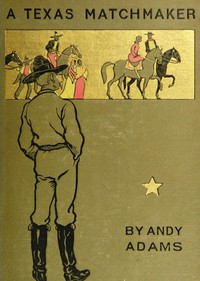
A Texas Matchmaker by Andy Adams (1859-1935) is free to read in full. Folio serves it in daily portions you can actually finish, tracks your streak and reading position across devices, and reads every page aloud with a built-in narrator. The text comes from Project Gutenberg.