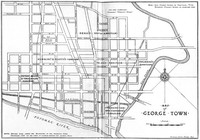
A Portrait of Old George Town
free to read
length
81,294 words
a few pages a day
~8 min
finished in
43 days
full read
5h 39m
At Folio's default of ten pages a day, you finish A Portrait of Old George Town in about 43 days — roughly 8 minutes of reading each morning.
The opening
the first pages of A Portrait of Old George Town, free
_The ghosts of Georgetown when they meet In haunted house or moonlit street With pride recall the functions gay When down the Philadelphia way The Federal City overnight Moved to its bare and swampy site, For Georgetown then a busy mart, A growing seaport from the start, Where a whole-hearted spirit reigned, Threw wide its doors, and entertained With wines and viands of the best-- The Federal City was its guest._
_In memory of the good old days, Whose ways to them were modern ways, Congenial ghosts across Rock Creek, With formal bows and steps antique, Rehearse a spectral minuet Where once in bright assemblies met-- Beruffled belles looked love to beaus In powdered wigs and faultless hose; Or merchant ghosts survey the skies And venture guesses weatherwise Regarding winds that will prevail To speed their ships about to sail._
_Still in the shaded hillside streets A trace of old-time welcome greets The passer-by who has a flare For scenes of old. No longer there A buoyant Georgetown stands alone, The Federal City having grown Until their boundaries overlap; So that, deleted from the map, Though once the Federal City's host, Georgetown itself is now a ghost._
Foreword
It is not at all in my mind to write a history of Georgetown. Several have been written, but I do want, very, very much, to paint a portrait of this dear old town of my birth where my parents, my grandparents, great-grandfathers and one great-great-grandfather lived, and which I love so dearly.
A portrait, partly of its physical features, its streets, its houses and gardens, some of which still exist in their pristine glory but, alas, many of which have gone the way of so-called progress. In place of the dignified houses of yore, of real architectural beauty, stand rows of cheap dwellings or stores, erected mostly in the seventies and eighties when architecture was at its worst. In 1895 it was that the old names of the streets were taken away and from then on we've been just an adjunct of Washington.
Not only of its physical side do I wish to tell, but I want to paint a picture of the kind of people who lived here, from the beginning up through the gay nineties--nearly one hundred and fifty years. Of the kind of things they did, their work, their play, their thoughts and their beliefs, for the character of the town, like human beings, was formed largely by their beliefs, and these old Scotsmen--for they were greatly in the majority--laid a great deal of stress on their Presbyterian form of Christianity. Witness the oath that had to be taken by the Flour Inspector on February 24, 1772: "I, Thomas Brannan, do declare that I do believe that there is not any trnsubstantiation in the Sacrament of the Lord's Supper or in the elements of bread and wine, at or after the consecration thereof by any person whatsoever."
And yet, with this strong prejudice, they coöperated and lived on friendly terms with the Roman Catholics who, very soon after the taking of this particular oath, founded their college and established their convent for teaching young girls.
Dr. Balch counselled well when he besought his people: "Let us resolve to be social rather than fashionable, and generous instead of extravagant."
All down through the years and to this day I think that has been the hall-mark of the real Georgetonian. A great deal of fashion has come to Georgetown, as in the early days of the bringing of the government when Washington City was a waste and almost entirely one big mud puddle, and the foreign ministers and many high in our government sought the comfort and dignity of this town, which was then far from young.
Again in later years there has been an exodus across Rock Creek of men and women high in the government; in the diplomatic corps; in industry; in literature and the arts; lured hither by the quiet dignity of the old-time atmosphere.
Keep going from exactly here — Folio remembers your place and serves the next portion tomorrow.
continue reading A Portrait of Old George TownAbout this free edition
A Portrait of Old George Town by Grace Dunlop Peter is free to read in full. Folio serves it in daily portions you can actually finish, tracks your streak and reading position across devices, and reads every page aloud with a built-in narrator. The text comes from Project Gutenberg.
More like A Portrait of Old George Town
The History of the Peloponnesian War
Folio
The History of the Peloponnesian War
Thucydides
The History of Herodotus
Folio
The History of Herodotus
Herodotus
The Gallic Wars
Folio
The Gallic Wars
Julius Caesar
Anabasis
Folio
Anabasis
Xenophon
The Lives of the Twelve Caesars
Folio
The Lives of the Twelve Caesars
Suetonius
Germania
Folio
Germania
Tacitus
The History of the Decline and Fall of the Roman Empire
Edward Gibbon
The Travels of Marco Polo
Marco Polo