length
52,344 words
a few pages a day
~8 min
finished in
28 days
full read
3h 38m
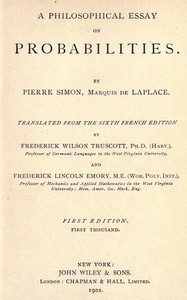
At Folio's default of ten pages a day, you finish A Philosophical Essay on Probabilities in about 28 days — roughly 8 minutes of reading each morning.
The opening
the first pages of A Philosophical Essay on Probabilities, free
This philosophical essay is the development of a lecture on probabilities which I delivered in 1795 to the normal schools whither I had been called, by a decree of the national convention, as professor of mathematics with Lagrange. I have recently published upon the same subject a work entitled The Analytical Theory of Probabilities. I present here without the aid of analysis the principles and general results of this theory, applying them to the most important questions of life, which are indeed for the most part only problems of probability. Strictly speaking it may even be said that nearly all our knowledge is problematical; and in the small number of things which we are able to know with certainty, even in the mathematical sciences themselves, the principal means for ascertaining truth—induction and analogy—are based on probabilities; so that the entire system of human knowledge is connected with the theory set forth in this essay. Doubtless it will be seen here with interest that in considering, even in the eternal principles of reason, justice, and humanity, only the favorable chances which are constantly attached to them, there is a great advantage in following these principles and serious inconvenience in departing from them: their chances, like those favorable to lotteries, always end by prevailing in the midst of the vacillations of hazard. I hope that the reflections given in this essay may merit the attention of philosophers and direct it to a subject so worthy of engaging their minds.
CHAPTER II.
CONCERNING PROBABILITY.
All events, even those which on account of their insignificance do not seem to follow the great laws of nature, are a result of it just as necessarily as the revolutions of the sun. In ignorance of the ties which unite such events to the entire system of the universe, they have been made to depend upon final causes or upon hazard, according as they occur and are repeated with regularity, or appear without regard to order; but these imaginary causes have gradually receded with the widening bounds of knowledge and disappear entirely before sound philosophy, which sees in them only the expression of our ignorance of the true causes.
Present events are connected with preceding ones by a tie based upon the evident principle that a thing cannot occur without a cause which produces it. This axiom, known by the name of the principle of sufficient reason, extends even to actions which are considered indifferent; the freest will is unable without a determinative motive to give them birth; if we assume two positions with exactly similar circumstances and find that the will is active in the one and inactive in the other, we say that its choice is an effect without a cause. It is then, says Leibnitz, the blind chance of the Epicureans. The contrary opinion is an illusion of the mind, which, losing sight of the evasive reasons of the choice of the will in indifferent things, believes that choice is determined of itself and without motives.
We ought then to regard the present state of the universe as the effect of its anterior state and as the cause of the one which is to follow. Given for one instant an intelligence which could comprehend all the forces by which nature is animated and the respective situation of the beings who compose it—an intelligence sufficiently vast to submit these data to analysis—it would embrace in the same formula the movements of the greatest bodies of the universe and those of the lightest atom; for it, nothing would be uncertain and the future, as the past, would be present to its eyes. The human mind offers, in the perfection which it has been able to give to astronomy, a feeble idea of this intelligence. Its discoveries in mechanics and geometry, added to that of universal gravity, have enabled it to comprehend in the same analytical expressions the past and future states of the system of the world. Applying the same method to some other objects of its knowledge, it has succeeded in referring to general laws observed phenomena and in foreseeing those which given circumstances ought to produce. All these efforts in the search for truth tend to lead it back continually to the vast intelligence which we have just mentioned, but from which it will always remain infinitely removed. This tendency, peculiar to the human race, is that which renders it superior to animals; and their progress in this respect distinguishes nations and ages and constitutes their true glory.
Keep going from exactly here — Folio remembers your place and serves the next portion tomorrow.
continue reading A Philosophical Essay on ProbabilitiesAbout this free edition
A Philosophical Essay on Probabilities by Pierre Simon marquis de Laplace (1749-1827) is free to read in full. Folio serves it in daily portions you can actually finish, tracks your streak and reading position across devices, and reads every page aloud with a built-in narrator. The text comes from Project Gutenberg.
More like A Philosophical Essay on Probabilities
Meditations
Folio
Meditations
Marcus Aurelius

The Enchiridion
Epictetus

Thus Spake Zarathustra
Friedrich Nietzsche
Beyond Good and Evil
Folio
Beyond Good and Evil
Friedrich Nietzsche
The Genealogy of Morals
Folio
The Genealogy of Morals
Friedrich Nietzsche
The Republic
Folio
The Republic
Plato
Apology
Folio
Apology
Plato
Crito
Folio
Crito
Plato